Plains Bison
There's a million things I could say about bison (Bison bison bison). They occupy a place in the American psyche like no other animal. Integral to human life on this continent for thousands of years, then treated as disposable, hunted to the edge of oblivion within a generation. Their story is long, complicated, and often tragic, and I don't want to gloss over that. But the most useful thing I can share from my time in North Dakota is how I actually approached photographing them, and what I learned in the process.
A little context first. When the park first opened in 1947, no bison lived within its bounds. The first animals arrived in 1956: 29 individuals transferred from Fort Niobrara National Wildlife Refuge in Nebraska. Today, the park maintains two conservation herds, and the bison you encounter there are plains bison, the subspecies (Bison bison bison) that once formed the famous buffalo herds of the American Great Plains. Plains bison are smaller and lighter in color than their northern cousins, the wood bison, and are adapted to the open grasslands and prairies of central North America. They are also, as I discovered, a genuinely fascinating and occasionally maddening photography subject.
Bison present a strange contradiction. They appear docile and slow, heads down, grazing across the landscape at a pace that feels almost glacial. Then, without obvious warning, they can move with surprising speed. They seem entirely indifferent to your presence, until the moment they very much are not. We've all seen the viral videos. The eyes are large and expressive, but buried in so much dense fur that finding focus on them can feel like a guessing game. An individual animal is striking. A herd is striking in a completely different way. I had set myself a challenge, mentioned in my previous post, to photograph bison across four styles: details, behavior, portrait, and environmental. Each one surfaced a different version of these contradictions.
Details
Despite the fact that you can't safely approach a wild bison, detail shots were surprisingly achievable with a little patience. The key was the bison jam. Anyone who has driven through Theodore Roosevelt National Park will know the experience: you round a bend, and suddenly the road belongs to the herd. You stop, they wander, and photography from the car window becomes not just an option but a genuine advantage, keeping both you and the animals calm.
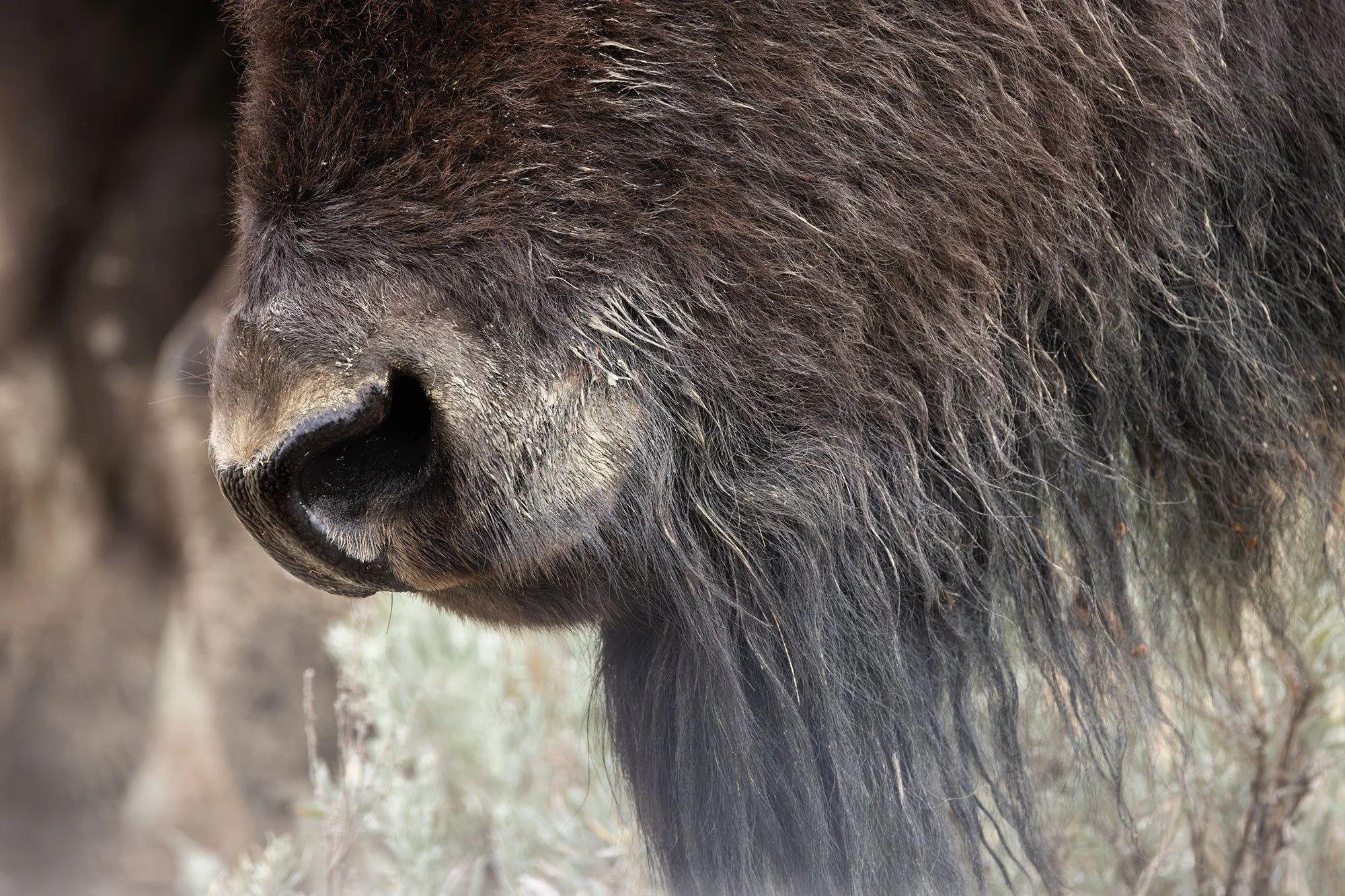
In those moments, I turned my lens to the smaller things. The obvious choice was the eye, that dark, liquid expressiveness framed by coarse fur. But my favorite detail shot was less expected: the nose and beard. That long, straggly chin hair is, in fact, correctly called a beard, and on bulls it grows longer than on cows, part of a heavier coat across the throat and dewlap that gives these animals their distinctive silhouette.
Behavior
Behavior was a trickier proposition, partly a matter of timing, partly of temperature. The bison rut peaks across the last two weeks of July and the first two weeks of August, which put us squarely in the middle of it. In theory, that meant the full spectacle was available: bulls bellowing across the landscape, wallowing to advertise their dominance, competing aggressively for breeding rights. In practice, the heat complicated everything. Many days pushed past 100 degrees Fahrenheit, and I couldn't imagine being wrapped in that thick fur coat. The animals were active, but not at their most dramatic.
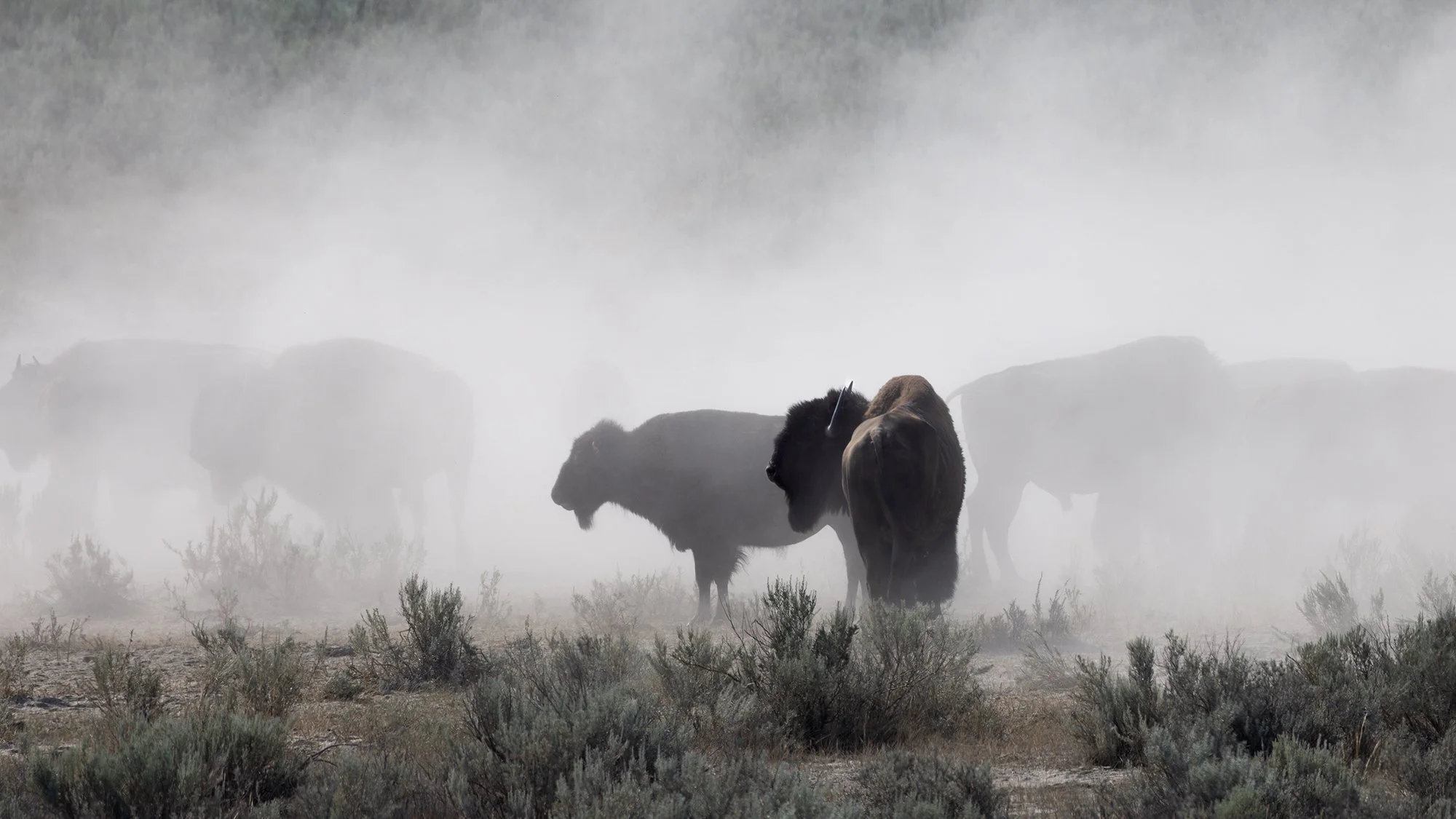
The most compelling behavioral moment came in the North Unit, where a herd in the middle distance began to wallow collectively. I'd read that wallowing serves several purposes beyond cooling down: bulls roll in the dirt to coat themselves in scent, advertising their condition to rivals and potential mates, and the behavior intensifies significantly during the rut. Watching it unfold in real time made that biology feel immediate. The wallowing kicked up so much dust that the herd began disappearing behind great billowing clouds of it. I was too far away to pick out individuals cleanly, but the scene had its own strange drama: dark shapes emerging from and fading back into the haze, the landscape briefly swallowing the herd whole. Sometimes the most evocative behavior shots aren't the ones you planned for.
Portrait
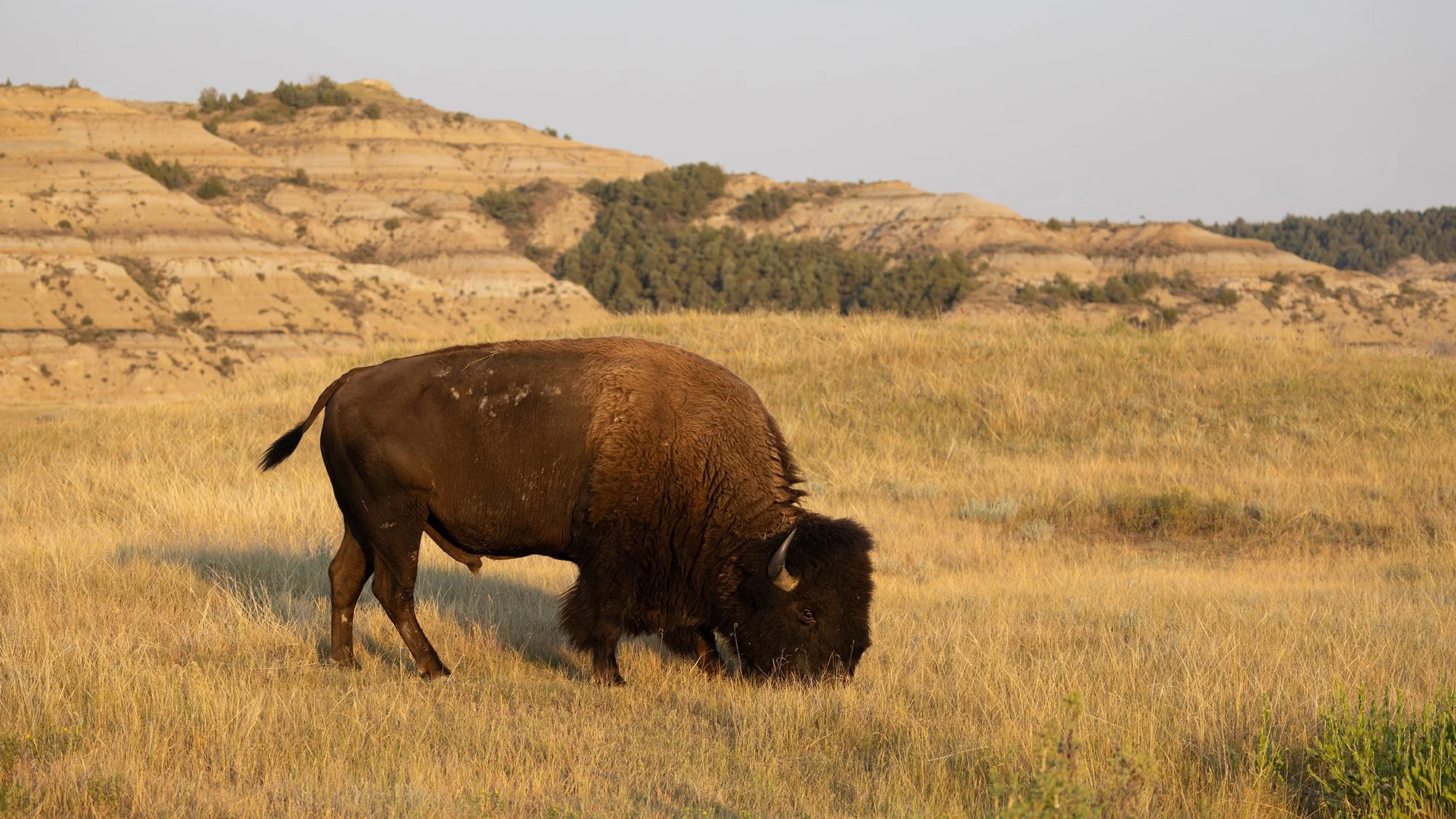
Portraits are my favorite kind of wildlife photography, and the opportunity I'd been waiting for arrived during golden hour: a solitary bull grazing against an open, beautiful stretch of badlands. The conditions were as close to ideal as I could have hoped for. And yet…
Zoom in too tight on a bison and the image risks feeling generic, a close-up of fur and horn that could have been taken anywhere. Pull back to show the animal in its landscape, and you're managing composition in real time against a subject that moves deceptively quickly for something that appears to be standing still. I was constantly reframing, repositioning to keep the light on the right side of the animal, and reminding myself not to step backward onto a cactus or a rattlesnake. Maintaining a safe distance from a large wild animal while navigating terrain you can't look at is its own particular challenge. It was, in the best possible way, a fun problem to have.
Environmental
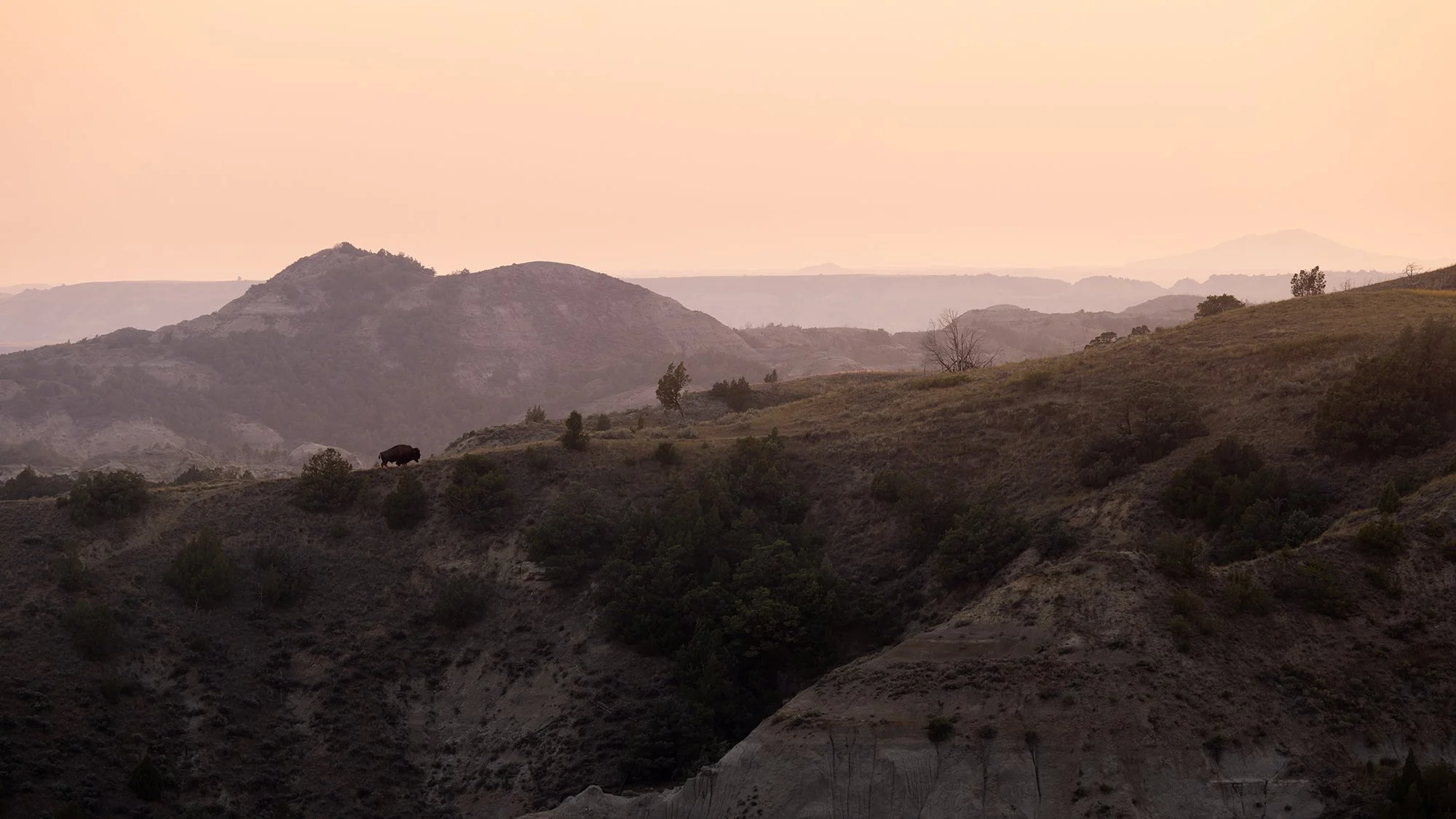
The environmental shot was perhaps the most straightforward of the four, though straightforward is relative with high-contrast badlands light. As the sun dropped toward the horizon, I spotted a herd moving along a ridgeline, their silhouettes darkening against the last of the light. The combination of landscape, movement, and fading color was already working. When one straggler drifted into the frame, completing the composition almost by accident, I had the shot. The hard part, as it turned out, came later: processing that much tonal range without losing detail in either the shadows or the sky.
Bison are remarkable subjects, in part because they ask so much of you. They're never just standing there waiting. Even at their most docile, they're an active negotiation between patience, distance, light, and a landscape that has its own strong opinions. I came away with images I'm genuinely pleased with, and a long list of things I'd do differently next time.